 Home
Testing the Buffer: How Households Use and Rebuild Emergency Savings
Emergency savings are meant to help households weather financial shocks. But how often are those buffers depleted, and how successfully do households rebuild them?

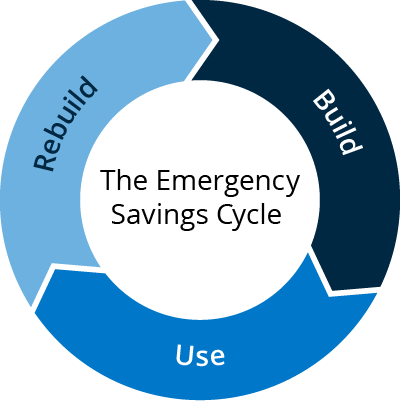
The Emergency Savings Cycle
BUILD: Households create a savings buffer to reduce exposure to hardship after a financial shock occurs.
USE: Households use the buffer to absorb an income disruption, expense shock, or life event.
REBUILD: Resilience ultimately depends on whether the household can replenish the buffer before the next disruption arrives.
Why Is an Emergency Fund Important?
Households with larger emergency savings buffers were much less likely to experience material hardship, including food, housing, or healthcare insecurity. Just 8% of households with at least six months of savings experienced a material hardship, compared with 61% of households who started with less than one week of expenses saved (Figure 1).
Figure 1. Hardship risk rose sharply with lower starting savings levels.
Share reporting any material hardship, by starting savings level.
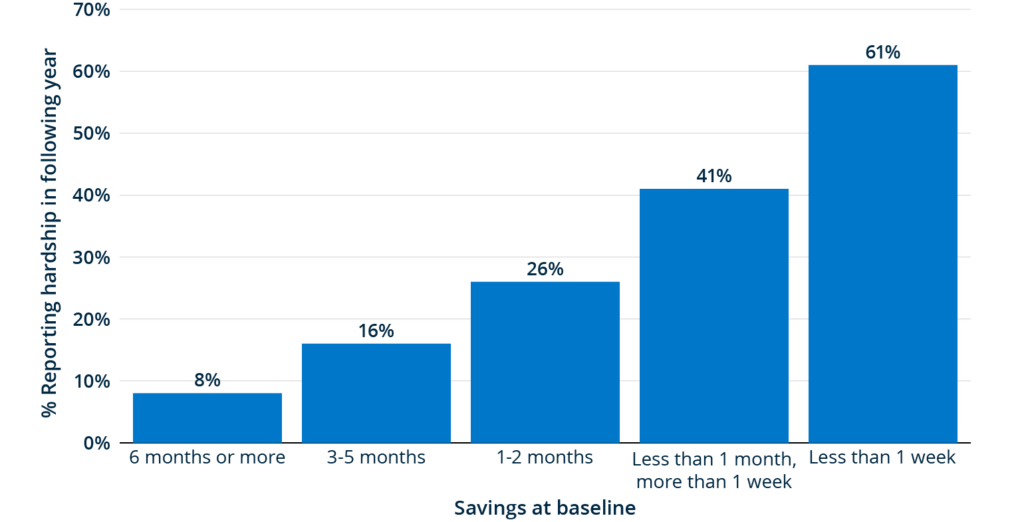
Notes: Longitudinal analysis of Financial Health Pulse data. Hardship is defined as any of four experiences in the past year: food insecurity, trouble paying rent or mortgage, forgoing needed healthcare, or skipping or reducing medication.
How Much Do Household Savings Change from Year to Year?
Household savings fluctuate substantially from year to year. In any given year between 2018 and 2026, nearly half of households surveyed moved to a higher or lower savings level, with shifts occurring across savings levels (Figure 2). Some households with relatively large buffers lost ground, while others who started with very low savings improved their position.
This volatility illustrates why a static savings balance provides just a partial picture of financial resilience. What matters is not only how much households have saved, but how those savings evolve over time.
Figure 2. Savings levels varied significantly from year to year.
Share of households whose savings grew, fell, or stayed the same, by starting savings level.
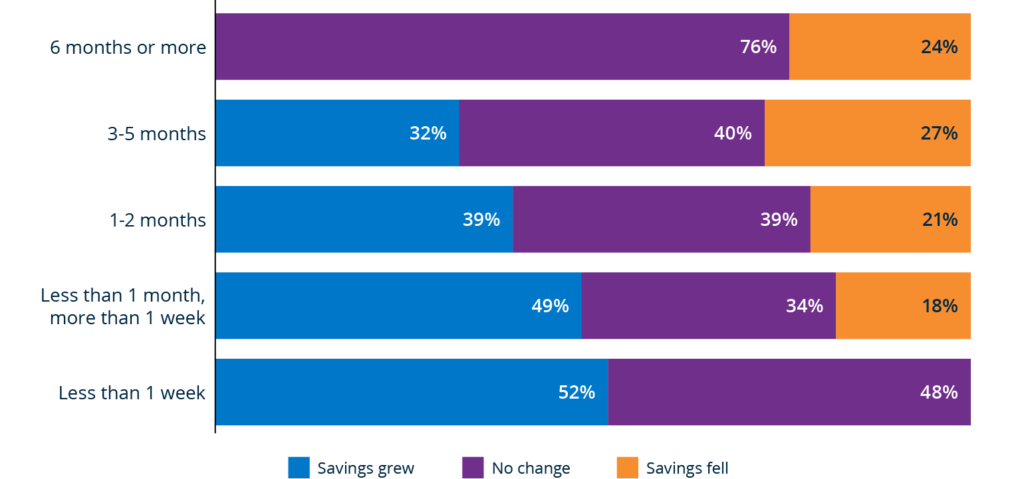
Notes: Financial Health Pulse longitudinal analysis of year-over-year transitions 2018-2026. N = 17,571 (6 months or more), 8,026 (3-5 months), 7,499 (1-2 months), 4,410 (less than 1 month, more than 1 week), 3,574 (Less than 1 week). Categories may not sum to exactly 100% because of rounding.
Which Financial Shocks Test the Emergency Savings Buffer?
Income shocks and unexpected expenses test a household’s emergency savings. Unexpected medical costs, major home or vehicle repairs, employment disruptions, income volatility, and divorces or separations were all associated with a greater likelihood of a savings decline (Figure 3).
Figure 3. Income shortfalls, income volatility, and some expense shocks were associated with a higher likelihood of savings declines.
Change in percentage of likelihood of experiencing a savings decline, by life event.
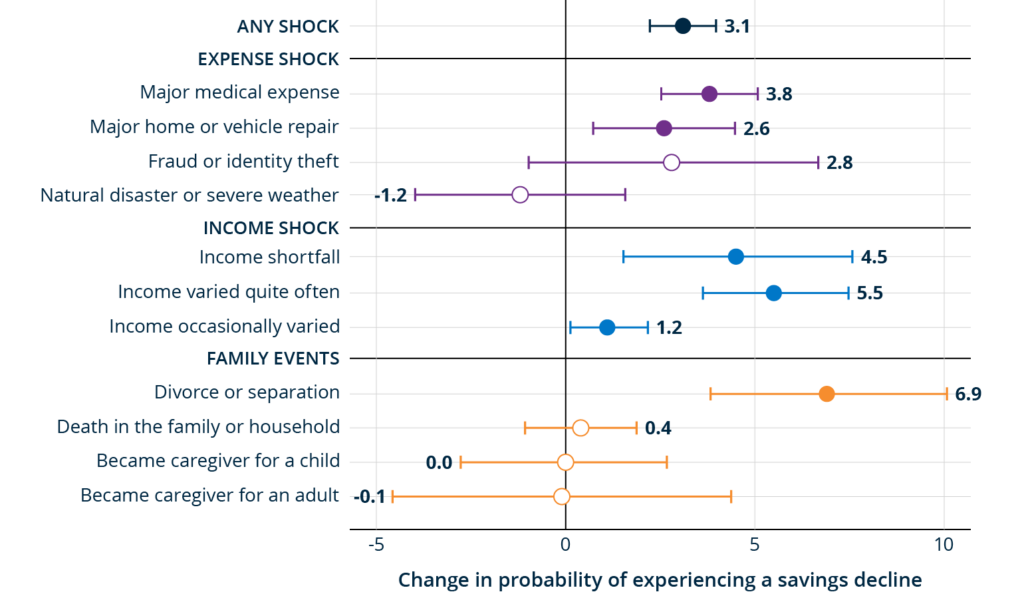
Notes: Points are adjusted percentage-point estimates and are coefficients from three linear probability models (N = 37,044, N = 36,896, N = 9,908). Lines show 95% confidence intervals. All models include year fixed effects and control for age, gender, race and ethnicity, Census region, education level, household size, income, insurance confidence, planning ahead financially, and baseline savings level. Standard errors are clustered by respondent. More information about regression specifications is available in Appendix.
How Long Does It Take Households To Rebuild Emergency Savings?
For many households, rebuilding an emergency fund takes more than a year. Among households who experienced a savings decline and were observed over the next two years, just under one-third rebuilt their savings within a year and stayed at or above their starting level (Figure 4).
For others, recovery took longer or didn’t occur within the period observed. A decline in liquid savings is not necessarily a sign of serious financial strain. The more revealing test is whether households are able to rebuild their emergency fund in time.
Figure 4. 4 ways a household’s savings can move after a decline.
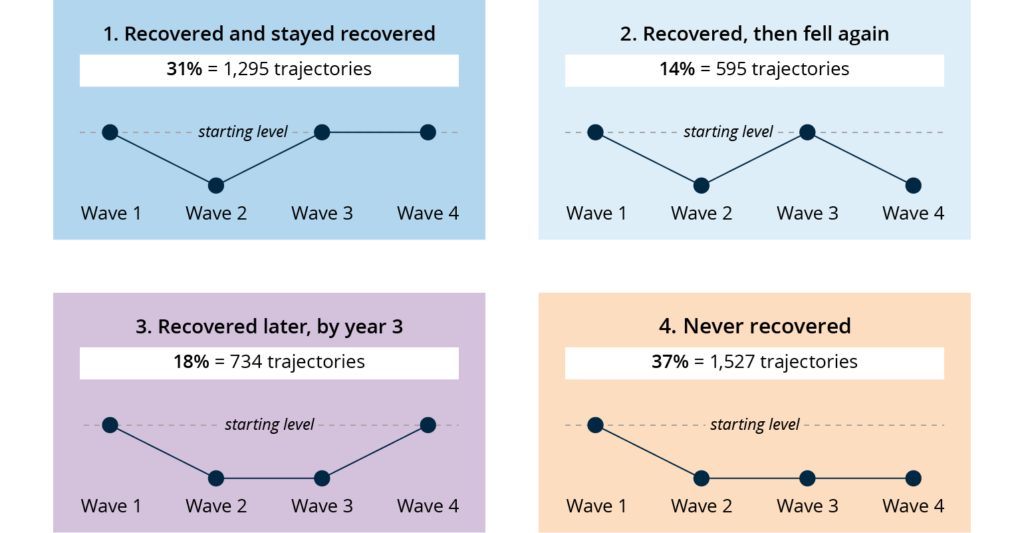
Notes: Financial Health Pulse longitudinal analysis. Limited to the 4,151 occurrences where a household’s savings declined and then were observed over two additional consecutive annual waves.
Our Funder
The Financial Health Pulse is supported by the Principal Foundation. The findings, interpretations, and conclusions expressed in this piece are those of the Financial Health Network and do not necessarily represent those of our funders or partners.



Testing the Buffer: How Households Use and Rebuild Emergency Savings
Explore the trends. Discover new insights. Build stronger strategies.
