 Home
HomeBringing FinHealth Into the AI Builders’ Room
As more people turn to AI for financial guidance, Carly Perera, Director of AI Strategy, makes the case for designing tools around the realities of people who aren’t Financially Healthy.

“Carly, I did it. I finally tried ChatGPT!”
My mom called me on a Tuesday afternoon, proud of herself. She’s in her 70s, living minimally off Social Security and a small pot of retirement savings that she has watched like a hawk for years. She still walks into her bank branch, waits for her favorite teller, and manually deposits checks while catching up on everyone’s business. She is not, by anyone’s definition, an early adopter.
But she’d recently gotten a letter about changes to her Medicare costs. Instead of calling me in a panic, she opened ChatGPT and asked what the letter meant for her monthly budget.
I was thrilled! I was also a little nervous.
Here’s the thing about my mom: for years, she ran her retirement scenarios on a notepad. Not Excel. A notepad. Oftentimes at 3 a.m. Her financial anxiety is grounded in lived experience. She’s experienced real financial instability both as a child and a mom raising three kids, working minimum-wage jobs into her 60s, and navigating the soaring rents of the Bay Area rental market on a fixed income. And here she was, using a general-purpose LLM to help her understand one of the most consequential letters she’d received all year.

Carly Perera and her mother circa 1985.
Medicare costs aren’t simple. They’re income-dependent and interact with Social Security in ways that can catch people off guard. For my mom, interpreting changes to her monthly budget depends on understanding her full financial picture, including her income sources, benefit mix, housing costs, and overall savings.
This time, the answer she got back from AI was solid, accurate, and helpful. But what about the next time she has a high-stakes question that keeps her awake at 3 a.m. and the model gets it wrong?
Financial Health Network research tells us that 69% of Americans are not Financially Healthy. They’re carrying debt, navigating benefit cliffs, and making financial decisions with no margin for error. And they are increasingly turning to AI for financial guidance, whether it’s through an LLM or, very soon, their bank’s app.
I’ve spent my career working at the intersection of financial health and innovation, and I know the people building AI tools right now genuinely care about their customers. Product teams are generally taught to design for the majority and deprioritize everyone else. The problem is, when it comes to financial health, people like my mom are the majority—they just keep getting treated like edge cases.
Many AI models are built on datasets that overrepresent financially stable, higher-income populations. This means the models learn patterns and behaviors that may not reflect the realities of Financially Vulnerable people living paycheck to paycheck. In this reality, even technically accurate financial guidance can miss something critical about a person’s financial life.
If AI is going to power the way millions of people receive financial guidance, we need better ways to design and evaluate these systems.

“Whether you are a two-person startup or a bank with millions of customers, the problem is surprisingly similar: there isn’t a shared way to evaluate whether an AI financial tool actually works for Financially Vulnerable people.”
Explore More

The Data Gap in AI Financial Guidance Tools
AI could democratize financial guidance, but the data needed to serve underrepresented consumers is often hardest to access. How do we close the gap?
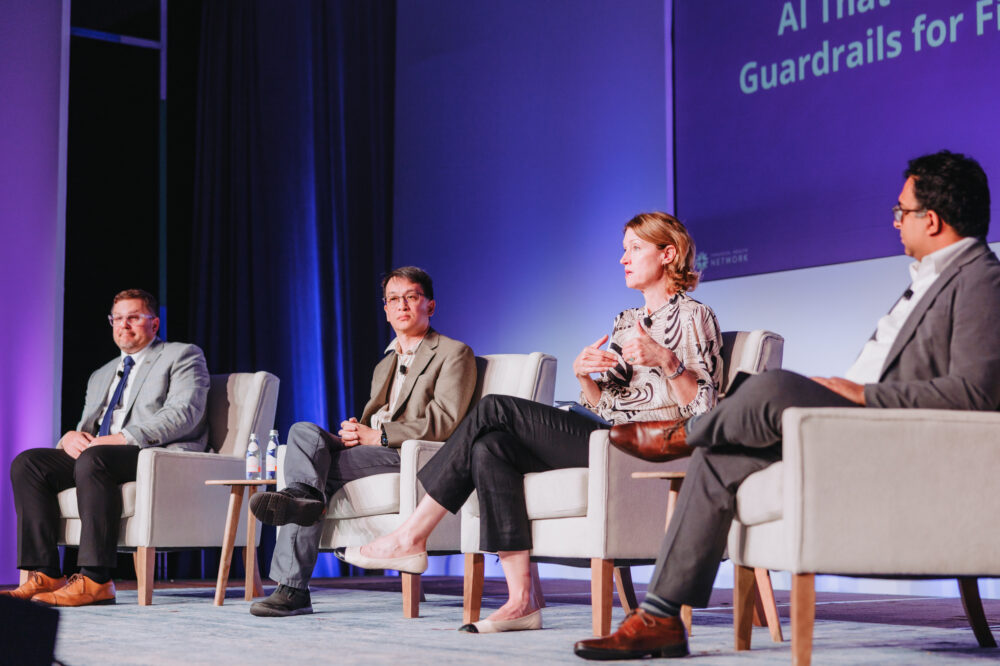
AI That Works for People: Guardrails for Financial Health
As AI reshapes how people get financial advice, get up to speed on the pillars of responsible innovation and explore safeguards to prevent bias, misinformation, and harm.

The Early Adopters: Who’s Using AI for Financial Advice?
AI is already transforming money management, but we have work to do to ensure it truly supports people’s financial decision-making and advances their financial health.
Written by
-
 Director, AI StrategyFinancial Health Network