 Home
HomeYNAB: Helping Users Make Smarter Spending Decisions With Money Labeling
YNAB, a zero-based budgeting app, shows how money labeling—a FinHealth Standard—can transform everyday spending decisions into long-term financial resilience.

Helping Consumers Replace Mental Math with Clear Financial Decisions
For many consumers, deciding whether they can afford a purchase comes down to mental math—a quick guess based on a bank balance or a recent transaction.
While commonplace, these estimations can quickly lead to financial strain and additional fees. More than 75% of consumers say they rely on mental math when making spending decisions, and nearly 1 in 5 consumers overdraft at least once a year, resulting in more than $12 billion spent in overdraft and non-sufficient funds (NSF) fees annually. Previous Financial Health Network research shows that 50% of overdrafters were unaware their account balance was insufficient to cover a purchase, while another 28% knew funds were low but proceeded anyway.
These common spending behaviors informed the foundation of You Need A Budget (YNAB), a zero-based budgeting app built on the philosophy of “giving every dollar a job.” The platform encourages users to assign purpose to the money they already have—not income they expect in the future—to help make clear, intentional financial decisions.

One of the key ways YNAB helps users move beyond mental math is with money labeling. Identified as a key practice in our FinHealth Standards for Spending Management Products, money labeling enables customers to visually set aside money within their accounts to specific categories—such as bills, planned expenses, or discretionary purchases—before purchases occur. Money labeling simplifies mental math, supports clearer planning, and creates psychological commitment by making financial intentions visible and actionable. This process helps users recognize the limits of their resources before making spending decisions to avoid accumulating debt.
Designing a Budgeting System Around Money Labeling
A large number on a screen doesn’t intuitively reflect the real-world trade-offs users face—like choosing between groceries and entertainment or deciding whether to pay a monthly bill or save for retirement. Rather than presenting users with a single account balance, YNAB embeds money labeling directly into the app’s interface, so users organize dollars into clearly defined categories.
By zooming in on individual budget categories, YNAB helps users go from a vague sense of what’s affordable toward concrete, intentional choices. This structured approach makes financial priorities visible and removes the need for mental math. Users can immediately see how much money is available and adjust their plans accordingly.
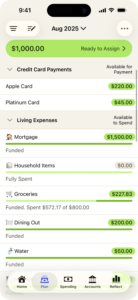
In addition to helping users create a plan for their money, YNAB helps users manage day-to-day spending. If a user overspends in a specific category, the platform frames this moment as an instructional opportunity—not a failure—by using bright colors, typography, and informative language. YNAB highlights where money is available to cover overspending, and the interface makes reallocating money straightforward. A tactile, drag-and-drop feature allows users to shift money between categories, helping them feel like they are physically moving money around.
Explore More Success Stories

Bank of America: Playing the Long Game
Discover how Bank of America’s decade-long commitment to Responsible Growth has yielded promising results for the business and consumer financial health.

BECU: Leading With Data To Advance Financial Health
BECU’s journey to improve member financial health led to a new strategy, an increase in data-driven initiatives, and positive outcomes for its members.

Jack Henry: Making Financial Health a Brand Promise
Financial technology company Jack Henry™ partnered with the Financial Health Network to help financial institutions and their accountholders alike break down barriers to financial health.