Blog

EMERGE 2026 Takeaways: 4 Solutions Worth Scaling

Explore key takeaways from EMERGE 2026, where 450+ attendees tackled financial health challenges from responsible AI and industry standards to community trust and new pathways to economic stability.

By Financial Health Network

Tuesday, July 7, 2026
 EMERGE 2026 Takeaways: 4 Solutions Worth Scaling
“Have you ever gotten out of bed and felt the whole room spinning?” 

Financial Health Network CEO Jennifer Tescher posed that question from the stage at EMERGE 2026 last month, using the feeling of vertigo to aptly describe the change happening all around us. As rapid technological and economic shifts rewrite the playbook for financial health, traditional financial pathways are no longer working for U.S. households—and cross-sector solutions must guide what comes next. Every decision we make today will shape the financial lives of millions in the years ahead. While we may feel daunted by the magnitude of what’s at stake, Tescher encouraged attendees to keep going: “We can’t stand still. We have to reorient.” 

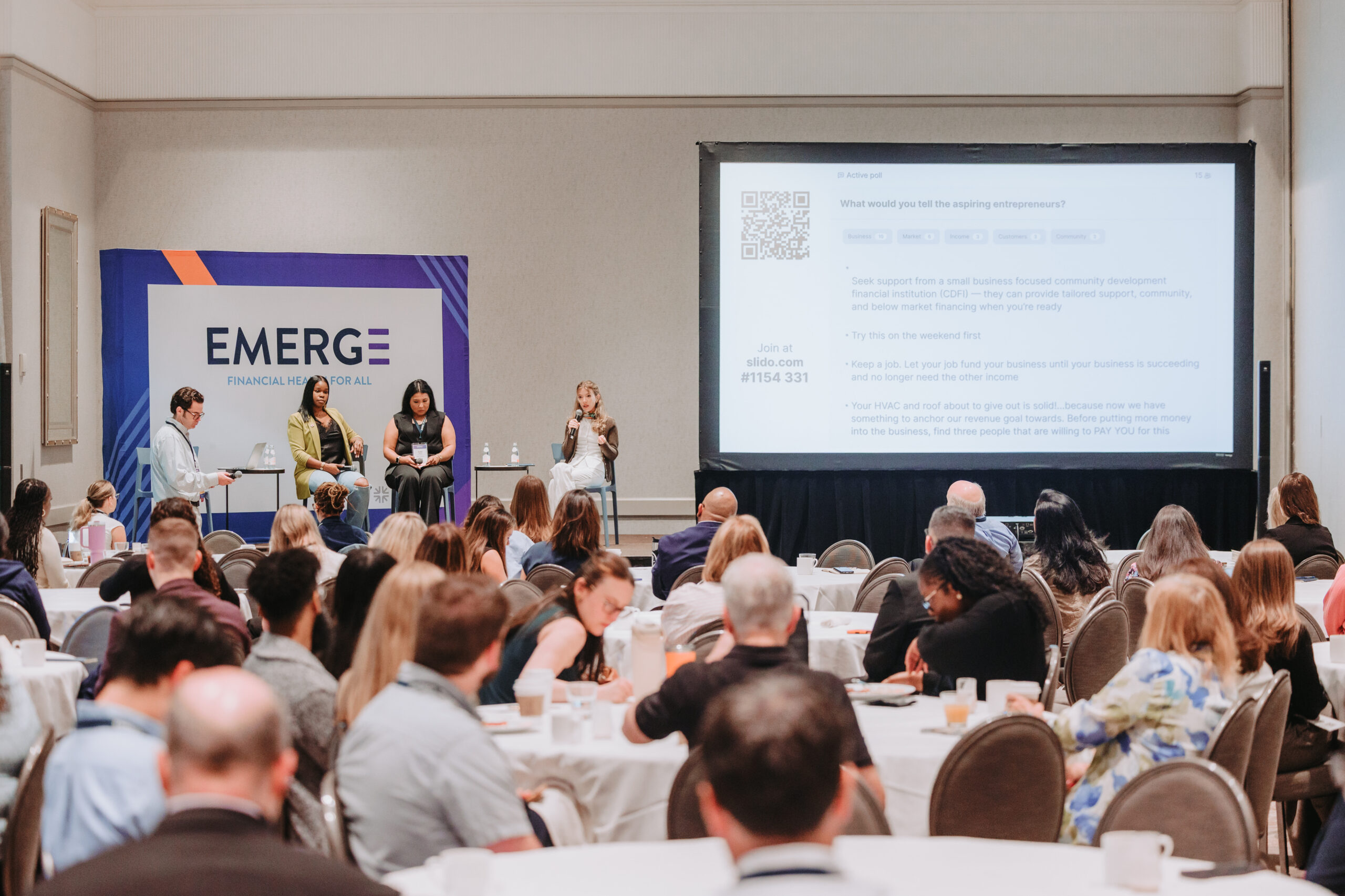
Over three days in Atlanta, more than 450 leaders working across financial services, fintech, nonprofit, policy, and beyond united to do just that. The conversations underscored precisely what makes the EMERGE experience unique: a trusted space where leaders can be candid—sometimes remarkably so—about what’s working, where they’re stuck, and how to move forward. As one attendee put it, the event featured “less performative talk and more honest discussions about whether solutions are truly improving people’s lives.” 

This year’s theme, “Scaling Progress, Shaping the Future,” recognized that meaningfully advancing financial health requires coordinated, cross-sector action. Speakers, panelists, and attendees focused on practical strategies to move from intent to impact, taking a clear-eyed look at everything from AI governance to measurement. Inspired by those conversations, here are four financial health solutions worth scaling and ways to put them into practice. 

Solution #1

Building New Pathways to Financial Stability

There is not a single county, metro area, or state in the U.S. where a full-time worker earning the local minimum wage can afford a two-bedroom apartment. Journalist Brian Goldstone shared that sobering statistic during his EMERGE session on housing affordability, illustrating how conventional financial wisdom—work hard and stability will follow—no longer holds true in an increasingly K-shaped economy. 

Essentials like childcare, housing, and higher education are rapidly outpacing incomes, leaving more Americans carrying staggering amounts of debt. In addition, one-third of all U.S. workers now participate in freelance, gig, or contract work, often assuming responsibility for retirement savings or healthcare benefits once provided by employers. Households need new systems that leave room for longer lives, variable incomes, and different starting points. 

Throughout EMERGE 2026, speakers highlighted dozens of innovations designed to help more people and communities build stability, including cash flow-based continuous underwriting for small businesses, employee stock ownership plans (ESOPs), and baby bonds. These solutions differ in form and function, but share a common goal: creating new pathways to wealth-building in an economy where traditional models fall short. As organizations explore how to scale these pathways, attendees also discussed the importance of solutions that are both context-specific and designed to serve consumers who have been historically excluded by financial systems.

Take the Next Step
Innovate alongside our Member community or by partnering with the Financial Health Network to test new solutions.

Arianna Ridderbusch, Vice President of Community Impact, Michigan State University Federal Credit Union

“If access is a choice, that means we can choose differently. Operating on the assumption that people are all financially stable with consistent income means we’re going to inadvertently exclude individuals. We need to look at how we support everyone in our community.”

Arianna Ridderbusch, Vice President of Community Impact, Michigan State University Federal Credit Union

Solution #2

Meeting Needs with the Right Industry Standards

What are the markers of “good” financial health? To create solutions that make a real difference, institutions need a shared reference point for what effective products and services look like. Voluntary industry standards can provide that North Star for operationalizing financial health, especially as federal regulations ebb. 

At EMERGE 2026, speakers examined the power of shared frameworks, such as the FinHealth Standards, to guide product design and deployment. Many leaders openly discussed how they’re shoring up organizational support for financial health, noting that gaining buy-in often requires reframing traditional measures of success. Capital One, for example, shared that eliminating overdraft fees led to a short-term revenue decline. Over time, however, those losses were outweighed by reduced business complexity, stronger Net Promoter Scores (NPS), and increased interest from prospective employees who valued the company’s commitment to its principles. 

Speakers acknowledged that meaningful change may take years to fully materialize, making it important to identify early indicators that build executive confidence and demonstrate progress. Ultimately, though, a successful financial health business strategy comes from aligning operations with values, not pursuing short-term returns. 

“At the end of the day, a spreadsheet isn’t going to tell you to do this work,” observed Ajamu Kitwana, Senior Vice President/Director, Purpose and Community at ESL Federal Credit Union. “Either you’re committed to it or you’re not. When you’re committed, you can figure out how to make it profitable.”

Take the Next Step
Explore the FinHealth Standards and join our just-launched Standards Leadership Program for guidance and peer support implementing the Standards within your organization.

Adam Davis, Vice President, Financial Health and Liquidity, Capital One

“Sometimes you step back and think, I have to do all these new things. It’s the act of working on these things that creates complexity and cost. I actually think it’s the opposite. When you’re not meeting your customers’ needs, that creates complexity and cost.”

Adam Davis, Vice President, Financial Health and Liquidity, Capital One

Solution #3

Taking a Human-Centered Approach to AI

It’s the question of 2026 (and likely the next few years, too). How do we harness AI to expand financial health, not widen existing gaps? 

AI holds immense potential to put financial advice in reach for more people, expand credit access through richer data, and inform and automate decisions across many aspects of our financial lives. But AI also comes with a slate of potential shortfalls. At its most foundational, AI cannot replace human judgment, empathy, or validation—three qualities that matter most during major financial turning points in our lives. For someone reeling from an unexpected medical bill, sudden layoff, or major life transition, a one-size-fits-all AI-generated response is rarely enough. Many leaders advocated for a hybrid approach, where AI supplements human connection rather than replacing it. 

Speakers also cautioned about responsible AI use. Baked-in biases, emerging privacy concerns, and cybersecurity threats are real risks for consumers, and institutions must design guardrails to ward against these risks. “There’s a difference between advice and action,” said Ted Leung, Chief Technology Officer at Prosprous.ai. “We’re not ready to start handing over bank account credentials to AI agents.” 

To develop products that adequately address the needs of all consumers, data portability must serve as the foundation. Cash flow, transaction history, credit records, and other data remain scattered across an increasing number of disconnected touchpoints. To provide truly personalized guidance, AI tools need access to a more complete view of an individual’s financial life. Without that foundation, AI risks reinforcing inequities or offering incomplete recommendations.

Take the Next Step
Explore our latest research on AI and partner with us to create or fund early-stage, AI-enabled solutions for financial health. 

Melissa Koide, Chief Executive Officer, FinRegLab

“We’re on a precipice with AI. This could be a really beautiful thing, or it could be a disaster if we’re not careful. There’s a lot we have to get right. We need to make sure that the data is representative of the people those models are being trained for and that consumer advocacy is engaged in thinking about the possibilities.”

Melissa Koide, Chief Executive Officer, FinRegLab

Solution #4

Building Trust and Partnerships Across Communities

“Even the best products will fail if people believe they are rigged,” Tescher cautioned during her keynote. That observation speaks directly to what one attendee called “the tension between access and outcomes.” Simply creating a solution is not enough. Institutions must earn the trust of the people they serve, design solutions with real needs at the center, and provide ongoing support to help people use products with confidence. 

Across multiple sessions, speakers explored practical ways to build trust with community members:

    • Treat empathy as a learned skill. When leaders consistently center empathy as a skill—not a fixed trait—and integrate it into institutional decision-making, the payoff is tangible, noted Jamil Zaki, psychology professor at Stanford University. Drawing from his research, Zaki linked empathy to higher levels of business innovation, engagement, and retention
    • Listen to customer needs. As GRO Fund Founder Hope Wollensack  put it, “Get out of your boardroom and come out into the streets.” When financial institutions are rooted in the lived experiences of their consumers, it has a cascading effect on product design and customer outcomes. That requires businesses to create solutions that serve diverse consumer mindsets, from helping people overcome financial trauma to creating the psychological safety needed to help people change ingrained behavior patterns. 
    • Be consistent and transparent. Trust is built through repeated actions over time. Speakers highlighted the importance of making good on customer commitments and being candid when things don’t go as planned. 

These tactics extend to the workplace, too. Jamil Zaki noted that economists estimate that disengagement at work costs the global economy around $9 trillion a year—meaning that organizations are leaving immense amounts of productivity and innovation on the table by neglecting to center connection and humanity in the office.

Take the Next Step
Explore our Human Stories Collection to hear more about the experiences of everyday people, or partner with us to fund additional StoriesHost a FinX to put your team in the shoes of customers, workers, or community members. 

Emi Reyes, Chief Executive Officer, Latino Economic Development Center

“Almost a year ago, we designed a program for federally laid-off workers in Washington, D.C. to move to entrepreneurship…. and it just quickly dwindled. It became so obvious that what folks wanted was their jobs back. We need to stop assuming that we understand everything that the community needs” 

Emi Reyes, Chief Executive Officer, Latino Economic Development Center

Keep the Momentum Going at EMERGE 2027

Since 2006, EMERGE has served as the leading platform for sharing ideas and driving action that improves financial health for all. Mark your calendar now to join us in Minneapolis, June 8-10, 2027, and continue shaping the future of financial health.