Brief

Peer-to-Peer Payments: Beyond Splitting the Bill

Since emerging in the early 2010s, peer-to-peer payments have become part of modern life. What do household usage trends reveal about financial health?
By Shira Hammerslough, Necati Celik, Ph.D.

Friday, March 6, 2026
 Peer-to-Peer Payments: Beyond Splitting the Bill

How P2P Use Reveals Shifting Financial Needs

Peer-to-peer (P2P) payments have rapidly transformed how Americans send, receive, and store money. What started in the early 2010s as a convenient way to split a dinner check has evolved into an essential part of everyday finances: 69% of U.S. households used P2P payments in the past year, and 40% used them at least monthly.1,2,3

Despite this widespread adoption, P2P use is not evenly distributed. Younger households, renters, part-time workers, gig earners, and families with children are more likely to rely on these platforms. What do these distinct user personas signal about financial health? Drawing on data from the 2025 FinHealth Spend Survey, this brief examines who uses P2P payments, how they use them, and what insights can be gleaned for providers and financial institutions.  

Key Insights on P2P Use

Explore the full brief to learn how P2P payment use intersects with financial health, and how P2P providers can center consumer financial health in product design. 

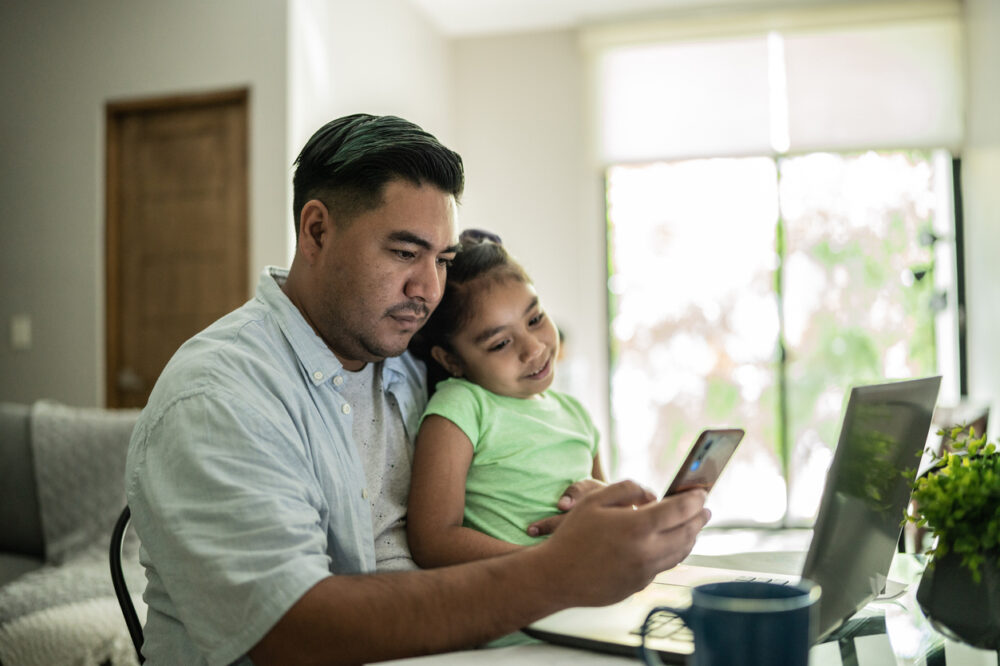
Father working with his daughter using laptop and mobile phone at home

P2P payments are widespread but used differently across households. In addition to users sending money to family and friends, P2P adoption is growing among households with children, entrepreneurs, and unbanked households.
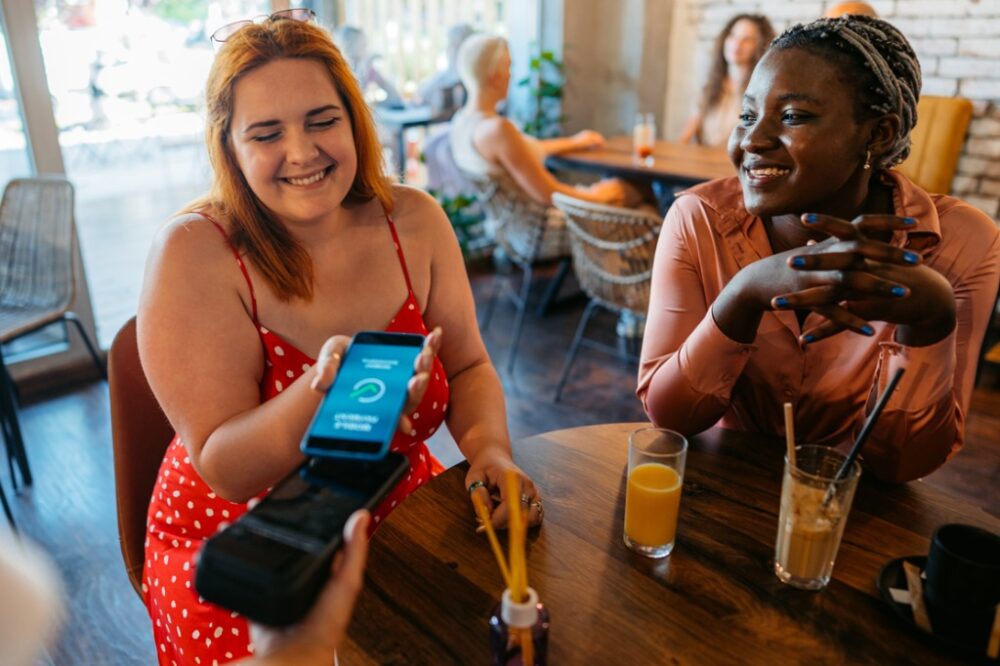
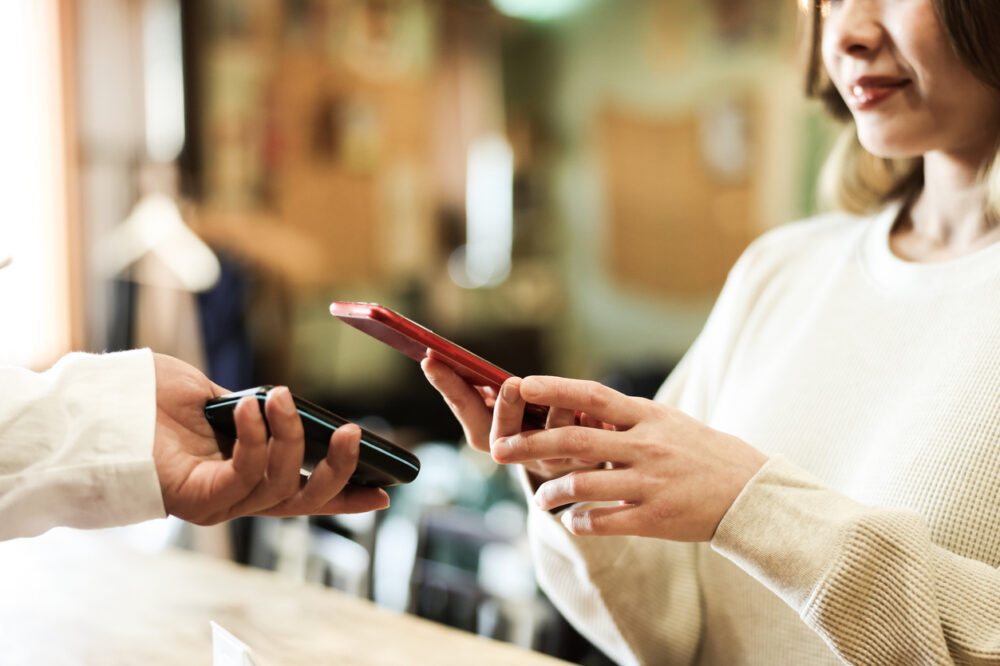
Young Woman Paying Via Contactless Channel By Mobile Banking Application

P2P users are disproportionately younger and more likely to rely on credit, revolving balances, and buy now, pay later (BNPL) services to address financial needs.
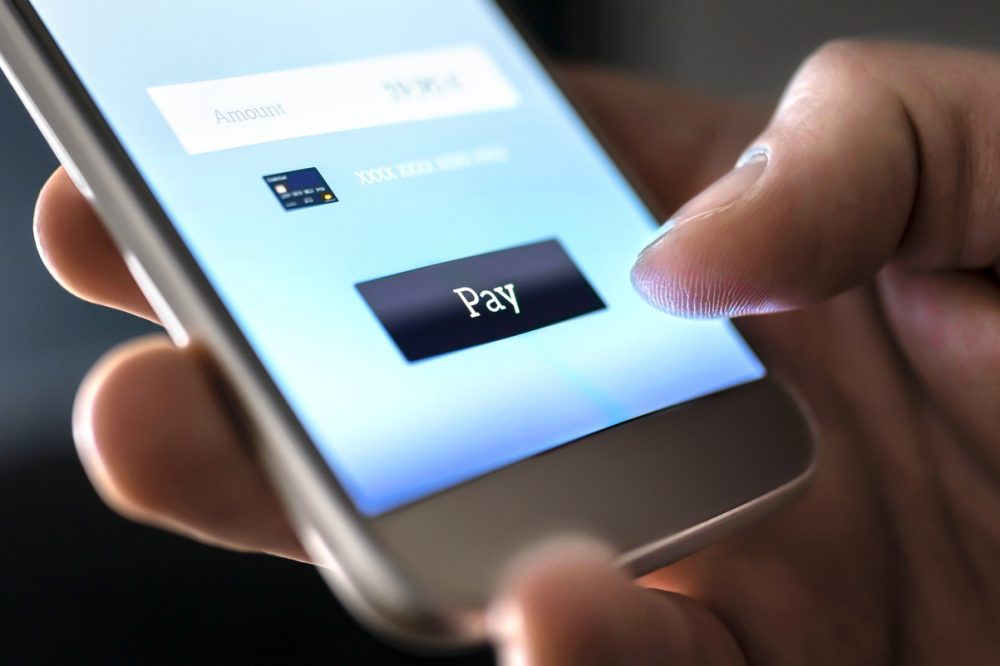
Man paying and shopping with smartphone application and credit card information.

For some households, P2P platforms fill important gaps in their financial routines. Nearly one-third of unbanked households use P2P apps to store money.

Data Spotlight: Is P2P a Substitute for Bank Accounts?

Nearly one-third of unbanked households using P2P payments, use it to store money, almost four times the rate among banked households. This finding suggests that some unbanked households may be relying on P2P platforms in place of a traditional bank account. 

Figure 1. Percentage of P2P users who use it to store money, by ownership of bank accounts.
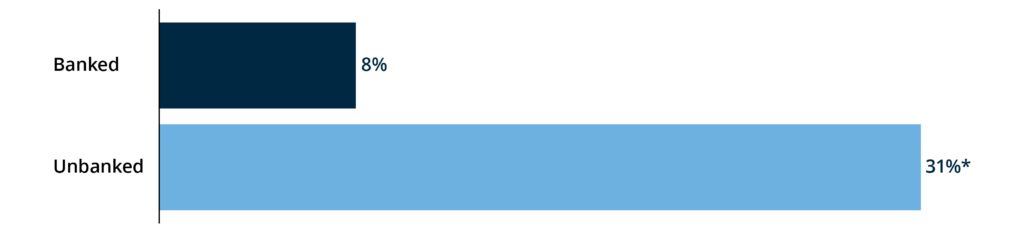
Horizontal bar chart showing that 8% of banked and 31% of unbanked P2P users use it to store money

Notes: Unbanked households are those that do not have a currently open checking or savings account. Sample size for unbanked households with P2P use is N = 61. Sample size for banked households with P2P use is N = 3,421.
* Statistically significant difference (p <0.05)

Our Supporter

This research was made possible thanks to the support of Block, Inc., owner of the P2P platform Cash App. We thank our colleagues Taylor C. Nelms, Beth Brockland, and David Silberman for their input. The opinions expressed in this research reflect our independent analysis and interpretation of the findings, and not that of the funder. 

Our Methodology

Our findings draw on the 2025 FinHealth Spend survey, which captured data on household usage of P2P services, other financial services and products, financial health, and demographic characteristics. We define P2P as online payment services that allow people to send, receive, and store money in a nonbank account (e.g., Venmo, Cash App, and PayPal). 


Endnotes
  1. The Rise of P2P Payments,” Clearly Payments, accessed February 2026. 
  2. ​​2024 Survey and Diary of Consumer Payment Choice Tables,” Federal Reserve Banks of Atlanta and San Francisco, 2024.  
  3. Peer-to-Peer Payment Services,” Consumer Reports Survey Group, January 2023. 

Written by

Shira Hammerslough

Associate, Research
Financial Health Network

Necati Celik, Ph.D.

Manager, Research
Financial Health Network

Peer-to-Peer Payments: Beyond Splitting the Bill

Explore the trends. Discover new insights. Build stronger strategies.