 Home
HomePolicyLink’s Michael McAfee: Building an Economy for the Next 250 Years
We sat down with Michael McAfee, CEO of PolicyLink, ahead of his main stage appearance at the Financial Health Network’s EMERGE conference in Atlanta, May 19–21, where he’ll explore what it truly takes to build an economy that lasts. Here’s what he had to say.
By Financial Health Network
-
Program:
-
Category:
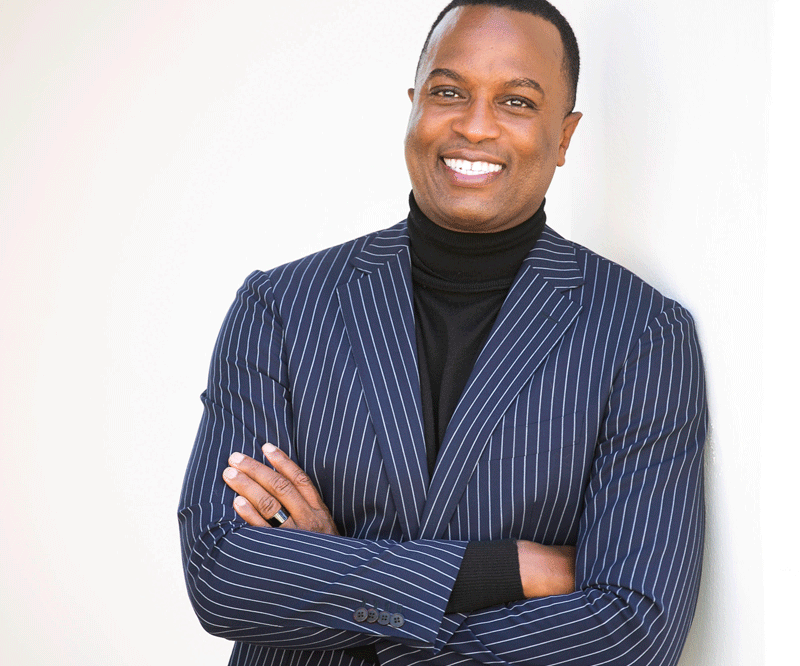
The following is an edited Q&A with Michael McAfee, CEO of PolicyLink, who will appear on the mainstage for the session “Founders of the Next 250 Years” at the Financial Health Network’s EMERGE conference in Atlanta, May 19-21.
If you were designing the economy today, what ideas would you add?
Two things come to mind, and I’d argue they’re inseparable.
The first is a genuine requirement that every business create value for society alongside generating returns. Right now, corporate charters and fiduciary duties are structured almost entirely around shareholder returns. I’d change that. Companies should be required to create durable, long-term value for shareholders while strengthening the workers, communities, and natural systems that healthy markets actually depend on. That’s not a constraint on business—it’s a more honest definition of what a thriving business looks like.
The second is making that expectation stick through public policy. Tax incentives, subsidies, preferential market access—these are enormous levers of public support, and right now they’re handed out with very few strings attached. I’d tie them to clear, measurable standards around job quality, community reinvestment, and responsible governance. Public resources should reinforce companies that are building strong businesses and strong economies at the same time. That alignment doesn’t happen automatically. It has to be designed.
What does America look like in 2050 if we get it right? What if we get it wrong?
If we get it right, the picture is genuinely hopeful. All workers earn living wages and have access to essential benefits that support their families. Economic opportunity is no longer determined by race, ZIP code, or inherited wealth. Capital markets reward long-term value creation rather than short-term extraction, and businesses compete within clear guardrails that align profit with shared prosperity. The mechanisms that currently trap people—predatory lending, opaque fee structures, exclusionary zoning, healthcare costs as a bankruptcy trigger—get structurally reformed rather than patched with charity. Crucially, trust in institutions improves because people can actually see the economy working for them.
If we get it wrong, the trajectory is much darker. More workers remain locked in precarity, with a growing share of people unable to meet basic needs. Wealth concentration accelerates as businesses face few guardrails on how profit is generated. And as economic power concentrates, it inevitably translates into political power—distorting policymaking, weakening democratic accountability, and feeding a deep loss of public trust in both markets and democracy itself. That’s not a hypothetical. We’re already seeing early signs of it.
How does financial insecurity erode trust in democracy?
When people work more than full time and still can’t afford basic necessities, it creates a visceral sense that the rules are rigged and that democracy isn’t delivering for working families. That’s not an abstract feeling. It’s a logical conclusion people draw from their own lived experience.
The federal minimum wage is still $7.25 an hour. There is not a single county in the United States where a family of four can meet basic costs earning less than roughly $25 an hour. Many workers are juggling multiple jobs and still falling short. When people see prices rising, wages stagnating, and policymakers failing to respond, that frustration doesn’t just disappear. It gets channeled, politically, in ways that can be deeply destabilizing.
But the flip side is equally true. When policymakers actually deliver—when a living wage passes and workers can support their families—it strengthens the belief that the economy and our democracy can work for everyone. Trust isn’t just eroded by bad systems. It’s rebuilt by ones that work.
Financial Health Network research has shown that earning at least a living wage is the strongest predictor of financial health, associated with a 6- point increase in FinHealth Scores®.
What should leaders start doing—and stop doing—to build the economy of the next 250 years?
What should you start doing? Use your influence to support clear economic guardrails and incentives—the kind that make markets work for workers, communities, and investors alike. Start aligning your capital, governance structures, and incentives around a clear, shared definition of what responsible economic participation means. Act with the full understanding that your business is not a neutral actor in how the economy operates. Every decision about wages, suppliers, lobbying, and capital allocation shapes the rules of the game. That’s power, and it comes with responsibility.
Stop treating responsible business practices as optional. They’re not a “values statement” or a PR exercise; they’re a prerequisite for long-term competitiveness.
Whether or not it is publicly acknowledged, there is a truth: no leader’s success is purely a product of their own design. There is a collective interdependence with government, with people, and with the planet that gets denied all the time, to our collective peril. Acknowledging that fact is the foundation of building something that actually lasts.