Financial Health Pulse® 2025 Chicago Trends Report

Small Gains, Big Divides, and the Path Forward for Chicago’s Financial Health
The 2025 Chicago Trends Report provides a comprehensive, neighborhood‑level analysis of financial health in Chicago and suburban Cook County. It examines how households are spending, saving, borrowing, and planning in the wake of economic volatility between 2022 and 2025.
The data show modest but meaningful improvements in overall financial health, including a slight decline in the share of Financially Vulnerable households. At the same time, our research documents persistent disparities across Chicago communities and between the city and the surrounding suburbs. Chicago remains a deeply divided city financially, with more households on both ends of the financial health spectrum than the U.S. overall.
At a moment when national discourse often portrays Chicago as a city in crisis, this research offers a more nuanced picture. Chicago is not a city in decline; it is a city at a crossroads, where resilience and inequity coexist, and where informed, place-based action can shape a more equitable future.
1. Financial vulnerability declined slightly, driven by improvements among historically vulnerable households.
Between 2022 and 2025, the share of Financially Vulnerable households in Cook County declined modestly, driven by improvements in spending, saving, and planning outcomes.
-
- Financial vulnerability decreased at the county level, driven by improvements in the financial health of Chicagoans.
- A smaller share of households reported having less than a week of savings to cover expenses, lacking confidence in reaching long-term financial goals, and either lacking confidence in insurance coverage or lacking coverage entirely.
- The decline in financial vulnerability was most profound for Black and Latino households. The financial health of Asian and white households remained steady.
Figure 1. Financial health in Cook County and Chicago, 2022-2025
Source: Chicago Financial Health Pulse Survey
Note: Sample sizes are in parentheses
*Statistically significant difference relative to 2022
2. Regional disparities persisted across the city and suburbs.
-
- Chicago households remained less Financially Healthy and more Financially Vulnerable than both the suburbs in Cook County and the U.S. as a whole.
- Chicagoans were more likely to struggle with paying bills, managing debt, and feeling confident in insurance coverage than suburban households.
Figure 8. Financial health in Chicago, suburban Cook County, and the U.S., 2025.
Source: Chicago Financial Health Pulse Survey
Note: Sample sizes are in parentheses
1 Statistically significant difference relative to suburban Cook County
2 Statistically significant difference relative to the U.S.
3. Financial health varied dramatically by Chicago region.
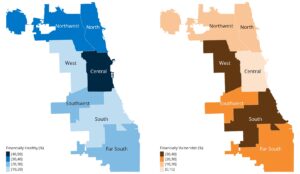
A place‑based analysis reveals stark differences across seven regions in the city of Chicago. Households in the West, South, Far South, and Southwest regions of Chicago were significantly less likely to be Financially Healthy and more likely to be Financially Vulnerable than households in the North, Central, and Northwest regions.
These regional divides mirror long‑standing patterns of segregation, disinvestment, and unequal access to wealth‑building opportunities within Chicago.
Figure 24. Share of Financially Healthy and Vulnerable households by Chicago region, 2025.
Source: Chicago Financial Health Pulse Survey
Note: Sample sizes are N = 1,127 (North), N = 975 (Central), N = 669 (Northwest), N = 460 (West), N = 994 (South), N =426 (Far South), N = 255 (Southwest).
4. Homeownership continued to lag behind national benchmarks.
-
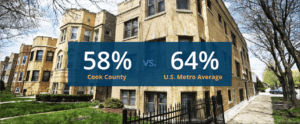
- 58% of Cook County households own their homes, compared to 64% of households on average across U.S. metro areas.
- Only half (51%) of renters who would like to own a home thought they were likely to become homeowners in the next five years.
- Not having sufficient financial resources and affordability were key obstacles to homeownership. Nearly three-quarters (70%) of renters who would find it difficult to buy a home today could not afford a down payment, and half (50%) thought there were not enough affordable homes, they had insufficient income, or found interest rates high.
- 6 in 10 Cook County households reported having positive net worth, with lower rates in the city of Chicago than in the suburbs. Nearly one-fifth of Chicago households reported negative net worth, meaning they owed more than they owned.
- Findings on household net worth underscored persistent racial and ethnic wealth disparities in Cook County. Fewer than half of Black (47%) and Latino (49%) households reported having positive net worth, compared with 77% of white and 67% of Asian households. Black and Latino households were also more likely to report negative net worth.
5. Credit and debt indicators for Chicagoans showed signs of growing strain
-
- Despite wage growth and steady employment, more Chicagoans struggled to pay off debt on time. Between 2022 and 2025, the share of borrowers 30 or more days behind on debt obligations increased from 26% to 29%.
- One-fifth of Chicagoans who are credit-visible had subprime credit scores, another fifth had near-prime scores, and the remainder had prime or above. These shares have remained largely unchanged since 2022.
Figure 5. Percentage of consumers 30 days or more delinquent in the past 12 months in Chicago, 2022-2025.
Source: TransUnion Consumer Credit Profile for Chicago
Notes: The sample for calculating mortgage delinquency is borrowers with an open mortgage trade. The sample for calculating delinquency in all trade is borrowers with any open trade, including mortgages.
-
- As rising prices stretch budgets, more Chicago households revolved credit card debt over the past few years. The percentage of credit card holders who revolve credit card debt has increased from 26% to 29% since 2022.
- The share of Chicagoans with more than $1,000 available across their revolving credit accounts has gradually decreased since 2022.
Figure 16. Percentage of credit card holders who revolve credit card debit in Chicago, 2022-2025
Source: TransUnion Consumer Credit Profile for Chicago
Note: Revolving credit card debt is defined as carrying a balance, net of payments, in that cycle and the preceding cycle, consistent with the CFPB definition.
6. Neighborhood perceptions improved across key quality‑of‑life measures, but housing affordability remained a concern.
-
- More Cook County households reported positive perceptions of many neighborhood amenities in 2025, including safety, cleanliness, open spaces, arts and culture, public transportation, and access to everyday services.
- Housing affordability remained a significant challenge in Cook County. Less than one-third of households rated affordability of housing in their neighborhoods positively.
- Only 46% of households reported that childcare in their neighborhoods was “high or moderate quality,” and just 48% were “very or slightly satisfied” with their options for jobs that offer a living wage and good working conditions.
Table 40. Neighborhood perceptions in Cook County
| All Cook County | ||
| 2022 | 2025 | |
| Excellent/Good | ||
| Recreation spaces | 71% | 72% |
| Cleanliness | 62% | 65% |
| Open spaces and natural amenities | 60% | 63% |
| Environmental conditions | 67% | 63% |
| Safety from crime | 50% | 56% |
| Vacancy levels | 55% | 52% |
| Affordability of housing | 27% | 29% |
| High/Moderate Quality | ||
| Arts, entertainment, and culture | 67% | 70% |
| Schools (K-12) | 62% | 62% |
| Childcare | 46% | 46% |
| Very/Slightly Satisfied | ||
| Places to shop and eat | 75% | 81% |
| Places to buy healthy food | 77% | 77% |
| Reliable public transportation | 67% | 69% |
| High-quality, affordable medical care | 61% | 62% |
| Jobs that offer a living wage and good working conditions | 50% | 48% |
| N | 5,417 | 7,762 |
Source: Chicago Financial Health Pulse Survey
Notes: Statistically significant changes are highlighted in green or red. Positive changes are highlighted in green, negative changes are highlighted in red. Vacancy levels refer to the share of storefronts and housing units that are currently occupied. An “Excellent” rating corresponds to low vacancy levels.
Conclusion
What Chicago Reveals About Financial Health in America
Chicago is not an outlier; it is a microcosm of national financial health challenges. A closer look at Chicago’s household data helps explain why crisis-driven narratives about Americans’ finances fall short.
Across the city, modest gains in overall financial health coexist with persistent pressures on day-to-day financial stability. While some households have seen improvements, many continue to struggle to pay bills on time, manage debt, and feel confident in their insurance coverage. These patterns mirror broader trends in financial vulnerability across the U.S., including:
- Rising income alongside fragile savings and cash-flow instability
- Uneven access to homeownership and long-term wealth-building tools
- Geographic concentration of financial vulnerability, driven by structural inequities
Understanding Chicago through a place-based financial health lens offers insights into not only where disparities persist, but also where targeted, neighborhood-level solutions can build upon these modest gains and accelerate progress.
A Place‑Based Framework for Financial Health
Chicago’s financial health outcomes are shaped by decades of racial, economic, and geographic segregation reinforced by discriminatory policies and chronic underinvestment.
To capture these realities, the 2025 Chicago Trends Report applies a place‑based framework across 77 community areas grouped into seven regions. This approach surfaces disparities masked by citywide averages and provides actionable insight for:
-
- Policymakers designing targeted interventions
- Funders allocating resources equitably
- Financial institutions developing inclusive products
- Community organizations responding to local needs
Interested in examining the financial health of your city or region’s residents?
Reach out to us at pulse@finhealthnetwork.org to explore your own place-based research initiative.
For national and Midwest comparisons, we used the 2025 U.S. Financial Health Pulse Survey. You can find detailed insights from this survey and its methodology in the Financial Health Pulse 2025 U.S. Trends Report.
A general population sample of U.S. adults aged 18+ with residence in Cook County, Illinois, was selected from NORC’s probability-based AmeriSpeak and ChicagoSpeaks panels. In addition, an address-based sample (ABS) from Cook County was selected and, together with the AmeriSpeak/ChicagoSpeaks sample, forms the probability base for this study.
Dynata’s nonprobability panel was used to assist with oversampling of small business owners, 18-24 year olds, and nontraditional workers. Lists of small business owners from two providers, Data Axle and Dun & Bradstreet, were used to assist in oversampling small business owners. A screener was used to confirm if zip codes provided by respondents from the ABS or nonprobability samples were within Cook County boundaries. The overall study target population is residents of Cook County, Illinois.
Related Research
Financial Health Pulse® 2022 Chicago Report
In our first report to focus on the Financial Health Network’s home city, we explore the realities of the financial lives of people in Chicago and neighboring Cook County suburbs.
Hawaii Financial Health Pulse: 2019 Survey Results
The majority of Americans are struggling financially – and the everyday economic reality is similar for those who live and work in Hawaii. The Hawaii Financial Health Pulse offers an in-depth view of their financial struggles and coping strategies, along with potential solutions to improve financial health across Hawaii and the rest of the country.
Acknowledgements
The Financial Health Pulse Chicago Trends Report is supported by The Chicago Community Trust and JPMorganChase. The findings, interpretations, and conclusions expressed in this piece are those of the Financial Health Network and do not necessarily represent those of our funders or partners.

Financial Health Pulse® 2025 Chicago Trends Report
By Necati Celik, Ph.D., Amber Jackson, Taylor C. Nelms
-
Program:
-
Category:
-
Tags: