In my 18 years at the Financial Health Network, one truth has remained constant: progress happens when people commit to building something together.
Cliché as it may sound, the new year is an especially apt time for commitments. One of mine? To keep up my Duolingo streak, currently standing at 1,329 days (yes, I’m quite proud of it!). Daily commitments can be surprisingly powerful, reminding us that small actions can lead to meaningful change. As we step into January, I keep returning to a simple question:
What if our commitments didn’t just improve our individual lives, but helped shift our society for the better?
The past year reminded us how quickly people’s financial lives can be disrupted. Rising costs, a volatile labor market, and rapid technological and political shifts left tens of millions of Americans falling behind. Then, a government shutdown and delays in SNAP benefits exposed cracks in core safety nets when people needed them most.
At the Financial Health Network, we saw the real-world consequences of these pressures through the people featured at our 2025 EMERGE conference and in our Human Stories series. Again and again, I was struck by how people’s financial lives don’t fit neatly into one box. A Los Angeles resident rebuilding after the wildfires faces insurance gaps and uncertain job prospects; a newlywed navigating a tight rental market and soaring utility bills driven by extreme heat.
These narratives echo what our data has long shown: Financial challenges are constant, interconnected, and too often worsened by systems not built for today’s realities. When people feel the odds are stacked against them, their trust in those systems frays. That erosion of trust chips away at the stability of our communities, economy, and society.
This is why, in the year ahead, we’re deepening our focus on rebuilding trust in the everyday financial systems Americans rely on—from financial services to workplaces to government programs. Committing to financial health is a critical step toward that goal. When our solutions reflect the realities of people’s financial lives, we create systems that work better for people and earn their trust over time.
2026 is the year to commit to financial health as our shared standard of success.
Financial health isn’t just about a person’s balance in their bank account. It’s about stability, dignity, and possibility. And we know that prioritizing financial health works, both for people and for businesses.
When Virginia Credit Union began measuring members’ financial health, it saw clearly that financially healthy members adopted higher-margin products. Chime’s helpful and affordable banking services have earned them a loyal customer base, with 75% of members saying they expect to remain with Chime for life. ING Netherlands has gained deep insight into how different products impact customer outcomes through its financial health measurement program, using the findings to sharpen its business strategy.
Now is the time to scale these wins, or risk continuing down a path of disparity, vulnerability, and fragility.
Progress begins with commitment. None of us can do everything at once. But if each of us commits to something—adopting a Standard, learning alongside peers, or innovating responsibly—we move closer to a future where financial health is the foundation of a thriving America.
Here are five commitments we’re inviting our community to make this year:
-
- Commit to Standards. Pilot at least one of our FinHealth Standards for checking accounts and credit cards to support consumer well-being and business success. Explore the FinHealth Standards.
- Commit to Measurement. As we roll out the next generation of financial health measurement tools in 2026, use our research and the FinHealth Score to benchmark your progress and build the evidence for change. Explore the FinHealth Score.
- Commit to Learning. Join us this May at EMERGE 2026 to discuss ways to build financial health at scale, then go deeper with our community of Members committed to taking action on financial health. Explore EMERGE & Membership.
- Commit to Listening. Lift up the voices of your customers, workers, and community members to shed light on financial needs and opportunities. Share a Human Story.
- Commit to Ethical Innovation. Take a governance-first approach to AI that centers the needs of Financially Vulnerable consumers. Explore Our AI Resources.
This is the moment to commit—or recommit—to making financial health our shared standard. I am deeply grateful for the work you’ve already done, and for what we’ll build together in the year ahead.
 Home
Home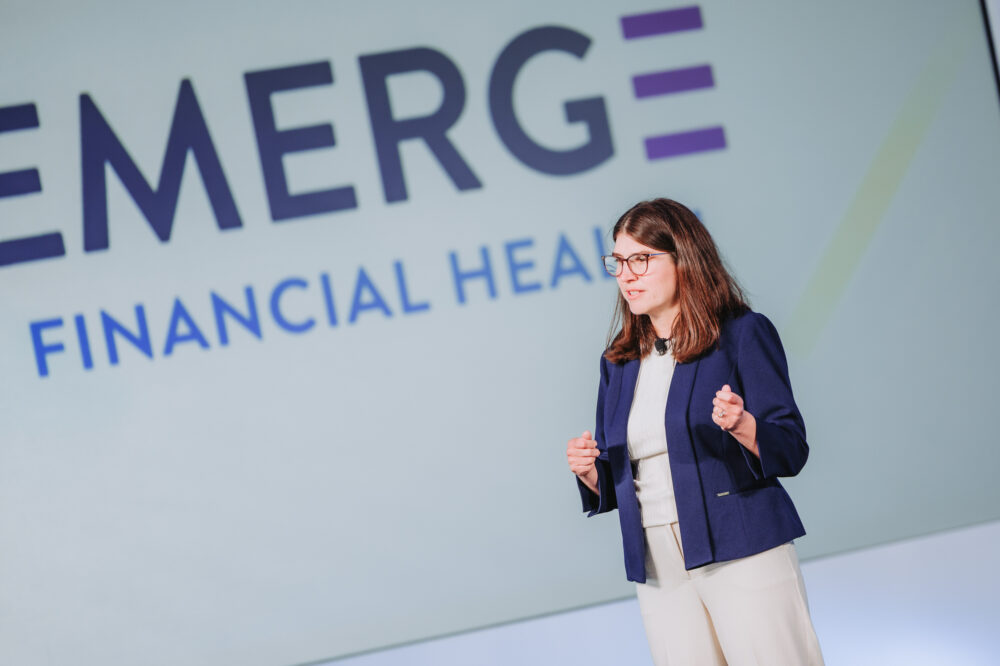



 PresidentFinancial Health Network